WHB Virtual Museum
Loading the museum…
Loading the museum…
Gallery VII: Faces in Flame
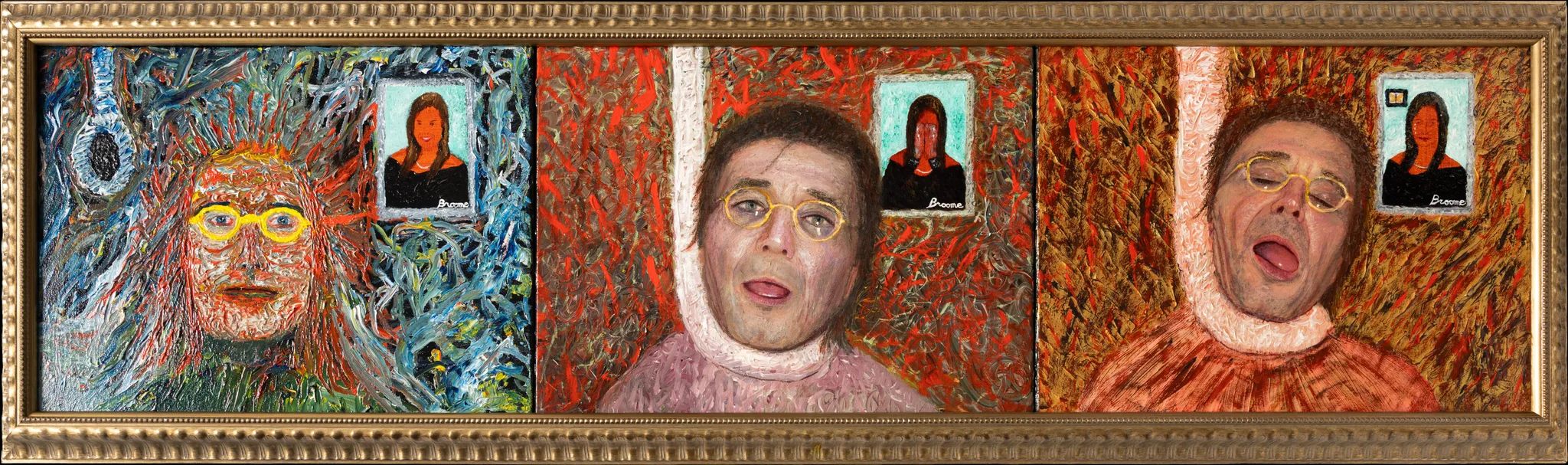
William Henry Broome
Curator’s reflection
BC-001 stands as one of the most important works within The Broome Collection.
As the opening piece of the museum archive, it immediately introduces viewers to the emotional language that defines William Henry Broome's artistic legacy. Rather than presenting a conventional self-portrait, Broome offers three psychological portraits-three versions of himself existing simultaneously within the same emotional landscape.
The composition unfolds from left to right like a visual narrative. The first figure is heavily textured, almost dissolving into an explosion of tangled brushstrokes. The face appears restless, searching for identity amid chaos. The surrounding environment is turbulent, suggesting intrusive thoughts, fractured memories, or emotional noise that refuses to become quiet.
The center panel shifts dramatically toward realism. Broome's features become more recognizable, yet his expression remains vacant and vulnerable. The white band encircling his neck immediately draws attention. Whether interpreted as restraint, suffocation, emotional confinement, or a symbolic noose is left deliberately unresolved. Throughout Broome's work, ambiguity becomes one of his most powerful artistic devices.
The final portrait carries the emotional weight of resignation. The figure tilts backward, mouth open, eyes partially closed-not necessarily in physical pain, but in emotional exhaustion. The progression across the three canvases resembles stages of an internal struggle: confusion, confrontation, and surrender.
An equally intriguing element appears repeatedly behind each portrait, a small, framed painting of a woman dressed in black. She never changes, never acknowledges the viewer, and never interacts with Broome directly. She functions almost like a silent witness. Whether she represents a real person, memory, lost relationship, unattainable comfort, or simply an emotional anchor is unknown. Her repeated presence quietly reminds viewers that some influences remain constant, even as a person's internal world changes dramatically.
Unlike traditional portraiture that seeks to preserve appearance, Broome paint’s emotional identity. Texture replaces precision. Color replaces certainty. Thick impasto brushwork creates movement that feels almost neurological, as though viewers are witnessing thoughts being painted rather than faces.
Viewed today, BC-001 becomes more than an artwork-it becomes the opening chapter of a visual autobiography. Knowing that William Henry Broome ultimately died by suicide lends the piece undeniable poignancy, yet the painting should not be understood solely through the lens of his death. Instead, it documents the long and often invisible struggle that preceded it. It reminds us that profound emotional suffering frequently exists beneath ordinary appearances, hidden from those who encounter us every day.
As the inaugural catalog entry of The Broome Collection, BC-001 establishes the central mission of this museum: not merely to preserve paintings, but to preserve a human story. Every brushstroke speaks to resilience, vulnerability, loneliness, and the enduring hope that someone, someday, might truly see beneath the surface.
Looking closer
A moment to reflect
Broome never painted simply to be observed. He painted to be understood.